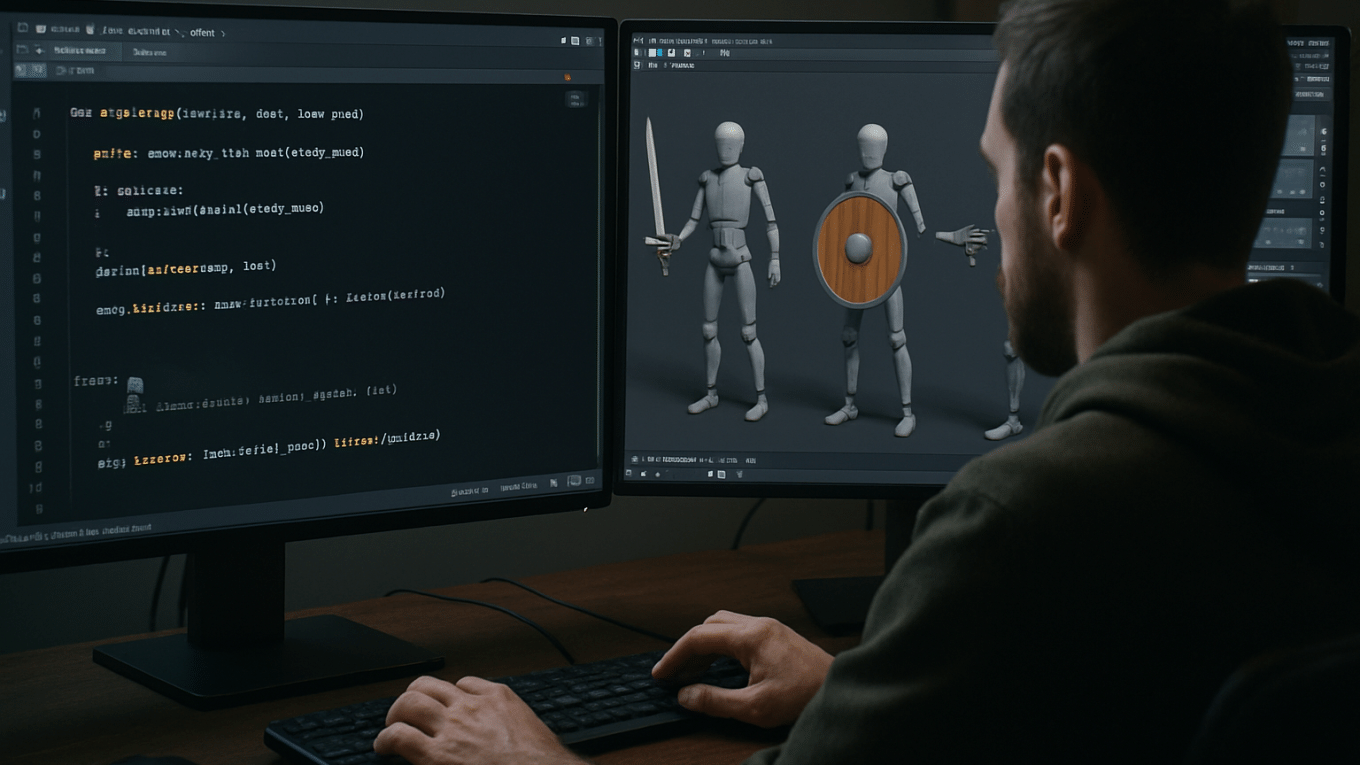
MCP server for 3D character prop integration: practical use cases for game studios
MCP server for 3D character prop integration: practical use cases for game studios
As development tools become more connected, studios are using MCP servers to expose 3D functions to AI agents, automation scripts, and internal editors. One of the most useful applications in 2026 is character prop integration: attaching weapons, gear, and accessories to rigged models through a structured interface rather than manual DCC work.
What an MCP server does in a 3D pipeline
An MCP server for 3D character prop integration exposes specific capabilities, such as attaching a prop to a hand socket or checking scale compatibility, as callable tools. Other systems can request those tools without knowing the internal file structure. This is useful when a team wants designers, QA tools, or AI assistants to prepare character loadouts without opening modeling software.
The main advantage: structured actions
Instead of sharing loose scripts, a team shares a common interface. A prop attachment action can be invoked with a clear request: character, prop, socket, and export options. The server handles the technical work and returns a result the rest of the pipeline can consume. This reduces ad hoc scripting and gives the studio a more consistent way to manage character equipment.
Practical use cases in 2026
Automated loadout preparation
A multiplayer game may need hundreds of weapon, armor, and tool combinations. With an MCP-compatible service, a build or design system can iterate through those combinations and produce aligned assets automatically. The team reviews only flagged results rather than every asset.
AI-assisted character setup
When a generative character model is created, it still needs equipment placement. An AI agent can request prop attachment through the MCP server, ensuring that the generated model receives weapons or accessories in the correct sockets. GripForge includes generation and editing of 3D characters, and its integration approach supports AI-driven character workflows.
QA and validation
A QA tool can call the server to verify that a character has no missing gear or that a weapon pivot is still aligned after a rig update. This turns prop integration from a manual art task into a checkable pipeline stage.
What a good MCP integration includes
- Clear tool definitions for attachment, validation, and export
- Support for batch requests
- Structured error messages that automation can parse
- Authentication and permission handling
- Compatibility with engine-ready formats
Bullet list: Questions for evaluating an MCP server
- Can I attach props to characters without a DCC license?
- Does it preserve skin weights and rig hierarchy?
- Can it handle non-standard skeletons?
- Is the API stable enough for production automation?
- How are failures reported to the calling agent?
How GripForge fits into automated character prop integration
GripForge provides API and MCP server integration for 3D character workflows. The focus is on practical game production: characters, weapons, props, and the operations that connect them. Rather than acting as a generic model converter, GripForge is built around the needs of game teams that must prepare characters and accessories for real-time use.
The service supports a shared 3D asset library, which means the characters, props, and textures used in MCP requests can be managed in the same environment. This is important because automation is only as reliable as the asset source. If the server cannot find the correct mesh or texture, the automation fails before any technical issue appears.
Common integration mistakes to avoid
- Using a tool that only returns transforms without a usable parent hierarchy
- Ignoring scale differences between characters and props
- Hardcoding bone names without a mapping layer
- Overloading the server with synchronous requests during peak hours
- Skipping visual validation before sending assets to game builds
Conclusion
An MCP server for 3D character prop integration makes equipment setup accessible to automation and AI tools. It reduces manual DCC work and makes large loadout pipelines easier to manage. GripForge offers this capability alongside character generation and a shared asset library, providing game studios with a connected environment for character and prop preparation. In 2026, teams that expose 3D operations through structured APIs will be able to scale content production faster than those still relying on manual file preparation.